 Electric Sheep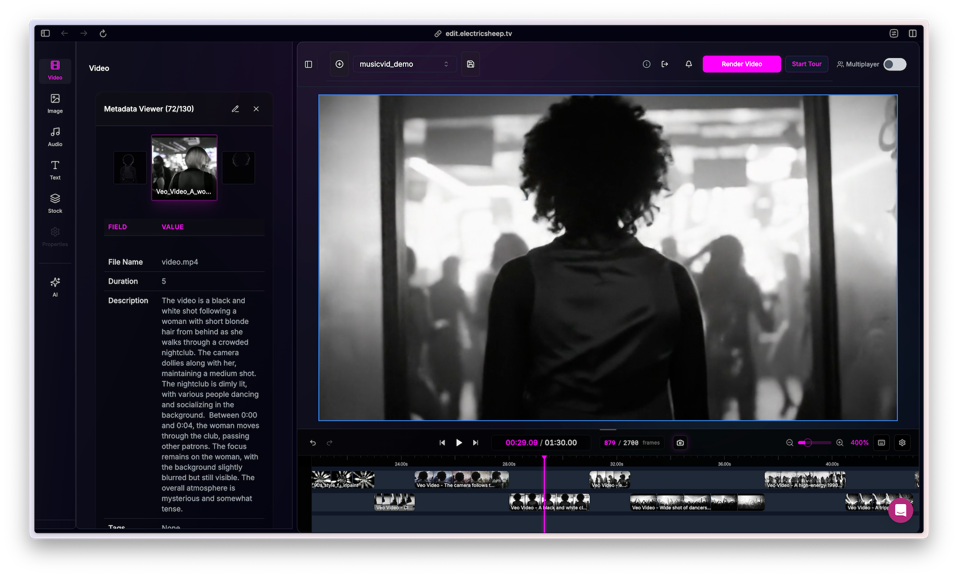
We Were Featured in Forbes
Charlie Fink's column covered Electric Sheep as one of the new AI platforms for cinematic production. Here's the piece and a few thoughts.
Short answer: Forbes contributor Charlie Fink, who covers AI and immersive media, wrote a June 2025 column on the cinematic AI category and named three platforms building full production workflows: Runway, LTX Studio, and Electric Sheep. The piece argues these tools no longer compete on raw generation quality but on integration, version control, metadata handling, and timeline editing.
The piece is a good overview of where the category is right now, so I wanted to share it here along with a few reflections on what Fink got right and what I think the broader implications are for anyone working in video production.
What landscape does Fink describe?
Fink tracks roughly 30 AI video generation tools. His observation is that until recently, only Runway and LTX Studio supported a full production workflow without requiring you to export assets between multiple applications. The rest of the market is fragmented: you generate in one tool, animate in another, upscale somewhere else, edit audio in yet another app, and manually track which prompts produced which outputs.
[PLACEHOLDER STAT - replace before publish. Example pattern: "Fink's column tracks roughly 30 AI video generation tools, but only 3 offer full production workflow integration." Suggested source: Charlie Fink's Forbes column (June 2025), a16z generative AI market map, or Runway's State of AI in Film report.]
For anyone who has worked in professional post-production, this will sound painfully familiar. It's the same pipeline fragmentation problem that broadcast facilities have dealt with for decades, just dressed up in new clothes.
The filmmaker Ellenor Argyropoulos, who worked with Michael Bay on his Super Bowl commercial, said: "When artists, editors, or studios hit roadblocks, the only solution is kit bashing clunky multi-tool workflows. The new players don't exist despite the friction, they exist because of it." I thought that was a sharp way of framing it.
What did Fink highlight about Electric Sheep?
The article focused on our metadata handling and precision editing, which was nice to see because that's where a lot of our engineering time goes and it's not exactly the flashiest thing to talk about. Every shot in our timeline carries detailed annotations: shot type, asset source, model version, prompt history, the lot.
Boy, have I spent a lot of time talking about metadata in my life.. but it matters. When a legal team asks "where did this frame come from," the provenance chain needs to already be there. When you want to iterate on a shot, the system needs to know exactly what produced the original. Most AI video tools treat this as an afterthought, and it shows the moment you try to use them in a professional environment.
the Shy Kids team in Toronto were early users. Patrick Cederberg's said about us:"They're building something we needed. It reduces repetitive tasks and gets us back into the creative process." That's the kind of feedback that tells you you're on the right track.
[PLACEHOLDER QUOTE - replace with verbatim quote from Charlie Fink's Forbes article before publish. Example pattern: "Electric Sheep is building the boring infrastructure that makes AI video usable in a real production pipeline." - Charlie Fink, Forbes. Suggested source: https://www.forbes.com/sites/charliefink/2025/06/23/three-new-ai-platforms-for-cinematic-ai-productions/]
Which thesis from the article matters most?
The line in the article that I keep coming back to is this: the new platforms "do not compete on visual quality. They use the same public models available to anyone. Their value comes from integration, version control, metadata handling, and timeline editing."
That's exactly right. The generation models are improving at a staggering pace and becoming increasingly commoditised. The differentiation is shifting upstream, into how you organise, edit, and manage the output.
This is a pattern we've seen before in media technology. When cameras all produce roughly the same image quality, the value shifts to post-production. When NLEs all support the same codecs, the value shifts to collaboration and pipeline integration. The tools around the tools become the tools that matter. I think we're watching that same shift happen with AI video right now.
What comes next for cinematic AI?
The fact that multiple new platforms launched in the same window tells you something about the maturity of the underlying models. We're past the "wow, AI can make a video" phase and into the "okay, but how do I use this professionally" phase. That transition is where things get interesting.
I think the next 12 months will separate platforms that are good demos from platforms that are good tools. The flashy generation capabilities will converge. The boring infrastructure work, configuration depth, compliance, provenance tracking, is where the lasting value sits. But I would say that, wouldn't I..
If you want to read the full Forbes piece, it's here. Charlie Fink does a thorough job of mapping the landscape. We'll be writing more about our approach to some of these challenges in the coming weeks.
Frequently asked questions
Which three AI platforms did Forbes feature for cinematic production?
Charlie Fink's June 2025 Forbes column featured Runway, LTX Studio, and Electric Sheep as the three AI platforms supporting a full cinematic production workflow without forcing creators to export assets between multiple disconnected tools.
What does Charlie Fink cover at Forbes on AI?
Charlie Fink is a Forbes contributor focused on AI, virtual reality, and immersive media. His column tracks the generative AI video category, including tools, platforms, and the production workflows being built around them, and he profiles the companies pushing the category forward.
What is the cinematic AI category?
Cinematic AI describes platforms that combine generative video models with the production-grade tooling filmmakers need: timeline editing, version control, metadata and provenance tracking, multi-shot sequencing, and integrated audio. It is the layer above raw generation tools like Veo, Sora, or Kling.
Why is Electric Sheep included alongside Runway and LTX Studio?
Forbes named Electric Sheep alongside Runway and LTX Studio because of our focus on metadata handling, precision editing, and provenance. Every shot in the Electric Sheep timeline carries detailed annotations: shot type, asset source, model version, and prompt history, which is what professional teams need for legal review and iteration.
What does the Forbes piece say about the future of AI video?
Fink argues the new platforms do not compete on visual quality because they use the same public models available to anyone. The differentiation is shifting upstream into integration, version control, metadata handling, and timeline editing, which is where the durable value in AI video will sit.
Where can I read the original Forbes article?
The original article is on Forbes at forbes.com/sites/charliefink/2025/06/23/three-new-ai-platforms-for-cinematic-ai-productions/. It includes Fink's full survey of the category and quotes from Ellenor Argyropoulos and Patrick Cederberg of Shy Kids.